
When we first got our hands on the Barista Touch Impress, we weren’t sure whether Breville had finally cracked the code on beginner-friendly espresso, or just figured out a really good way to charge $1,500 for it. So we put it to the test for this Breville Barista Touch Impress review.

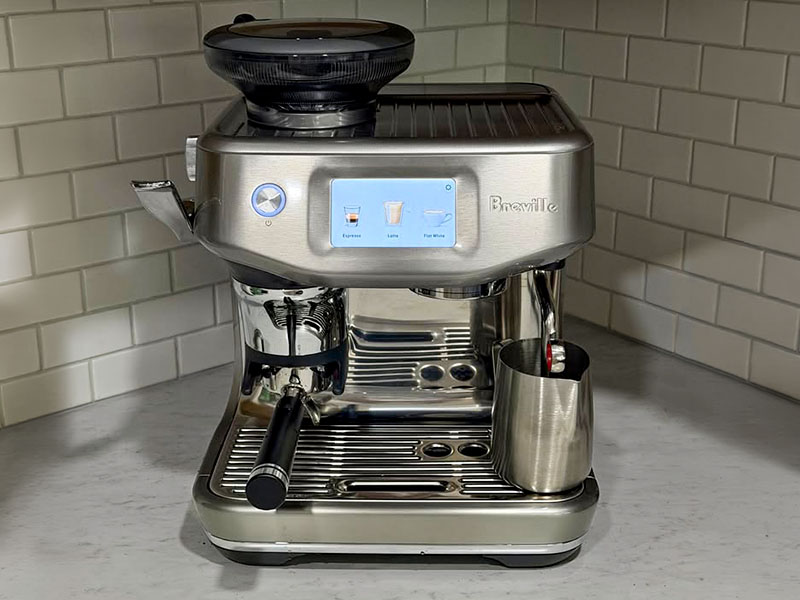
The Breville Barista Touch Impress is the best espresso machine for anyone who wants to pull their own shots but doesn’t have the time or energy to hone all the steps. It will help you get the right grind size and tamp pressure, and it’ll perfectly foam the milk for you. All at a level far higher than any super-automatic espresso machine at the same price.
It does require more work than a super-automatic, so it’s a small trade-off of convenience for quality. For us, the quality upside is well worth it. However, we’ve heard of people having issues with the intelligent dosing being off by 1g, and while we’ve not encountered this issue, it’s something to be aware of.
Breville espresso machines aren’t for everyone. There’s more work involved than some people want in persuit of awesome coffee. We’ve been making hundreds of coffees with the Barista Touch Impress so we can tell you what it’s like to live with one, and help you to decide if it’s the right machine for you. Let’s get to it:
This article may contain affiliate/ compensated links. As an Amazon Associate, we earn from qualifying purchases at no additional cost to you. For more information please see our disclaimer here.

At a Glance: Breville Barista Touch Impress Review
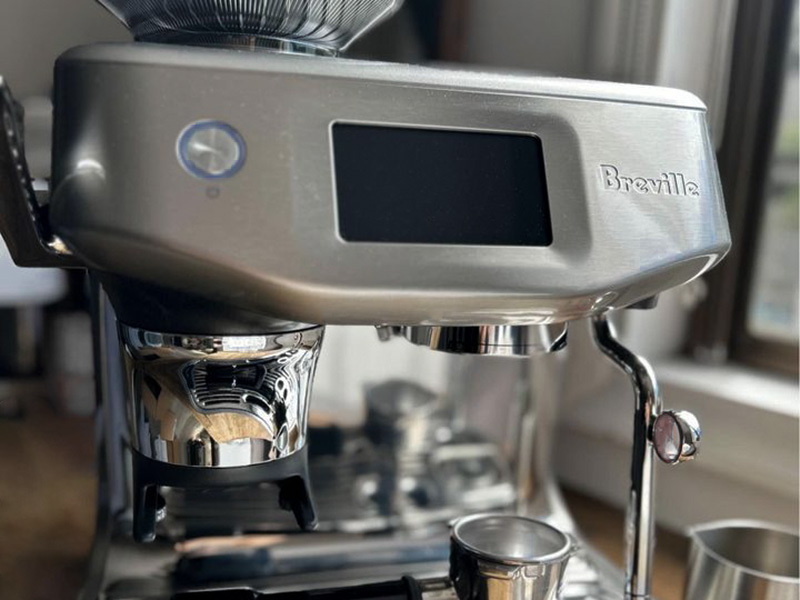
Verdict: The Barista Touch Impress does what it promises – it makes genuinely outstanding espresso and silky milk drinks, with enough help built in that you don’t need to know what you’re doing.
The Impress tamping system is the standout, taking one of the most skill-dependent parts of home espresso making and ensuring it’s repeatable from day one. And the on-screen grind guidance takes the guesswork out for anyone who’s never dialed in an espresso machine before.
It’s not perfect: the preset drinks menu feels restrictive for the price, and Auto MilQ has a mixed reputation among users, though ours performed well. If you go in with realistic expectations and give yourself a morning to dial it in, the results are honestly impressive.
Bottom line: This is a fantastic machine for quality espresso and milk without you having to do the work. There’s clearly some inconsistency, but if getting the best coffee at home without learning to pull shots yourself is the goal, it’s a great option.

Pros
- Auto tamping for consistency
- Barista Guidance for easy dialing in
- Outstanding espresso
- Cafe quality milk
- Ready in 3 seconds
- Top quality grinder
- Excellent touchscreen

Cons
- Preset drinks can’t be edited
- Auto MilQ is hit and miss for some users (good for us)
- Large footprint


Who It’s For (and Who It’s Not)
✅ Buy the Breville Barista Touch Impress if:
- You care deeply about espresso quality. Breville espresso machines (not just this one) can produce espresso far better than any super-automatic at the same price. If quality espresso is your goal, a Breville is a great shout.
- You want to be involved in the process. While the Barista Touch Impress will help you with every stage of the process, you’re still very much involved in making your morning coffee – it’s not a hands-off process.
- You like to customize your drinks. The level of control the Breville Barista Touch Impress offers from strength to temperature to milk consistency is incredible.
- You use plant-based milk. Breville’s MilQ technology has specific settings for oat, almond, and soy milk as well as cow’s milk. Whilst this is becoming more common, it’s still not standard across espresso machines and makes a big difference as the fat content and ability to froth vary wildly between milks.
- You want to learn to pull your own espresso. The Barista Touch Impress offers training wheels that you can eventually take off when you become comfortable pulling your own espresso and foaming your own milk.
❌ Skip it if:
- You’re looking for easy espresso. While nothing is difficult, there are a lot more steps than if you get a classic super automatic machine.
- You’re short on counter space. At 13 inches wide, this machine won’t easily slot onto a busy countertop. Not ideal for anyone short on counter real estate.
- You want lots of preset drink options. The Barista Touch Impress only has a few basic coffee options, with the ability to save some of your own. If you like trying lots of different espresso drinks without thinking, this might not be ideal.
- You’re already well-versed in making espresso. A lot of the features of the Barista Touch Impress are designed for people who are new to making espresso at home. If you’re already familiar with dialing in espresso shots, then you won’t see the benefit of most of the features you’re paying for with this machine.

Key Features Review
1. Impress Puck System
This is one of the most impressive features of the Barista Touch Impress and takes a lot of the guesswork and confusion out of the hardest part of making espresso – getting the puck right.
It uses an intelligent dosing sensor, assisted tamping, and auto-adjustments to make it a breeze for you to dose and tamp your grounds, whether it’s your first time or your hundredth. When you set your grind and tamp with the lever, the Barista Touch Impress will then tell you if you need more or less grounds for a perfect puck. It also stores that information for next time so you’re not starting from scratch with each drink.
This feature is what sets this machine head and shoulders above the Barista Touch… though you pay an extra $500 for it too.
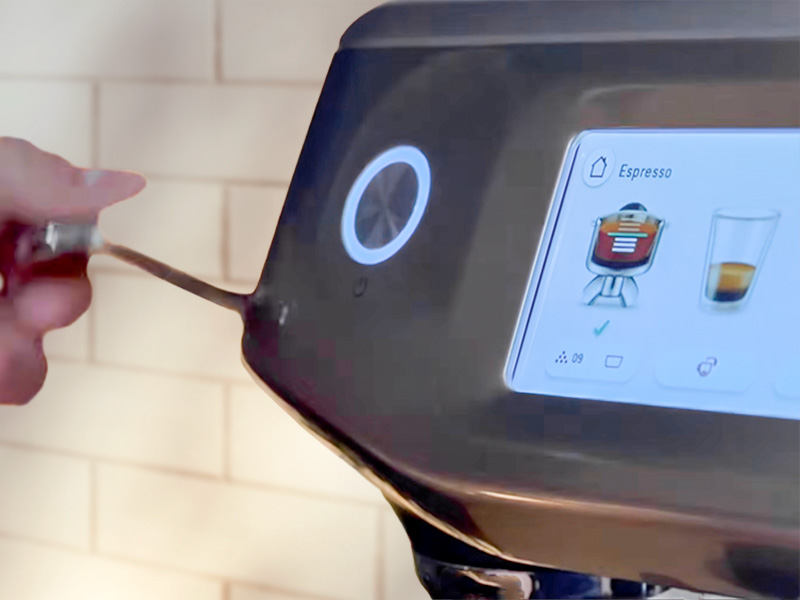
2. Cold Brew Coffee and Espresso
It will never not annoy me that espresso machines say “cold brew” when what they really mean is lower-temperature extraction. It’s a super cool feature, it’s just not cold brew (which needs to brew really slowly over 12-18 hours) so we need to collectively come up with a new name for it.
That aside, by brewing colder and slower than regular coffee/espresso, you get less acidic notes in the cup, resulting in a noticeably sweeter, smoother-tasting coffee. It takes just under 3 minutes to brew coffee and just under 2 minutes for espresso. You can choose to add ice, cold foam, tonic water, or whatever iced coffee recipe is tempting you.

3. Baratza Grinder
The integrated Baratza conical burr grinder has 30 grind settings and is calibrated to grind fine enough for espresso. This gives you the flexibility to fine-tune your grind setting to suit a wide range of coffee bean styles and roasts.
4. MilQ System
The automatic milk system allows you to choose the temperature and texture of your milk to suit the drink that you’re making.
What is extra special is that you can choose between dairy, oat, soy, and almond milk, and the Barista Touch Impress will automatically adjust to ensure you get the right texture with that milk type. This is a really impressive feature for those who enjoy dairy alternatives.
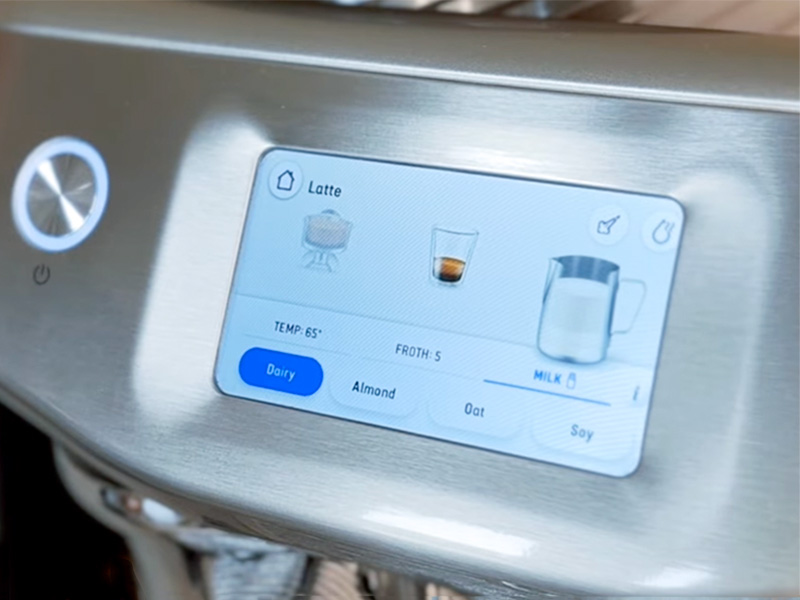
5. 13 Preset Drink Options
Whilst the list of pre-programmed drinks isn’t extensive, it does include all the popular cafe favorites, a lower temperature foamed milk for the little ones (or your dog!), and some fun recipe ideas. You can also save up to 6 custom drinks made to your exact specifications.
Since the Barista Touch Impress was first released, Breville has released a firmware update that, once downloaded, increased the number of preset drinks. And they might do this again in the future. So if you like the look of one of these drinks but it’s not on your machine, check that it’s up-to-date:
- Espresso
- Americano
- Flat white
- Cappuccino
- Latte
- Cold brew
- Cold espresso
- Babyccino
- Hot chocolate
- Tea
- Espresso shakerato
- Latte shakerato
- Espresso martini
6. Barista Guidance
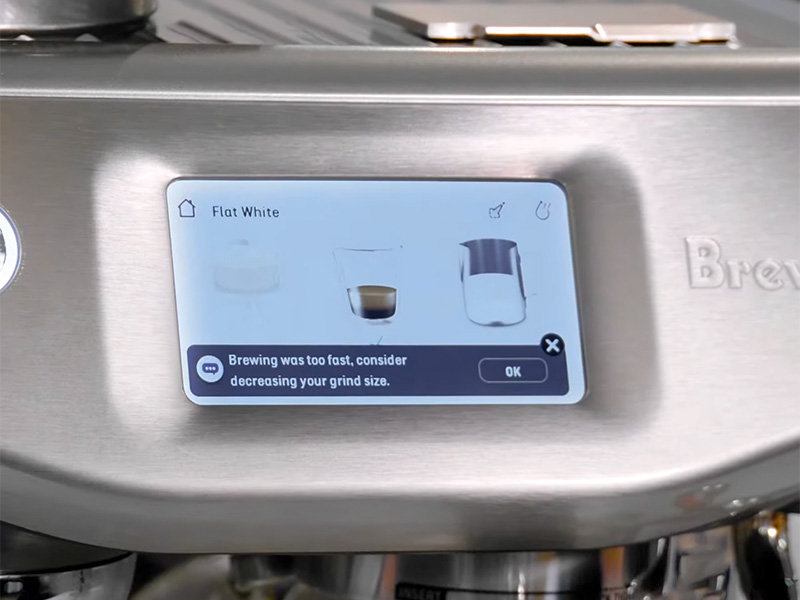
If you’re brand new to espresso machines and the concept of “dialing in”, Breville has you covered with their genuinely helpful “Barista Guidance.” When using new beans, the Barista Touch Impress can help you work out how to get the best-tasting espresso shots. It does this by detecting how fast/slow your shot takes to brew, then advising to grind finer or coarser to improve.
This is hugely helpful to anyone new to brewing espresso at home and intimidated by working out grind sizes. It uses real language and doesn’t overcomplicate things, which I love, as it allows you to work through the steps and learn from it in real-time.

How Easy to Use is the Breville Barista Touch Impress?
The screen and tech on the Barista Touch Impress make it as easy to use as it possibly can be for this type of espresso machine.
Going in, you need to know that it’s not a super-automatic or bean-to-cup machine. You have to do a little manual labour to get your coffee. That said, Breville has put a lot of effort into ensuring that the amount of learning you need to do is almost zero.
You need to dose, grind, and tamp your puck.
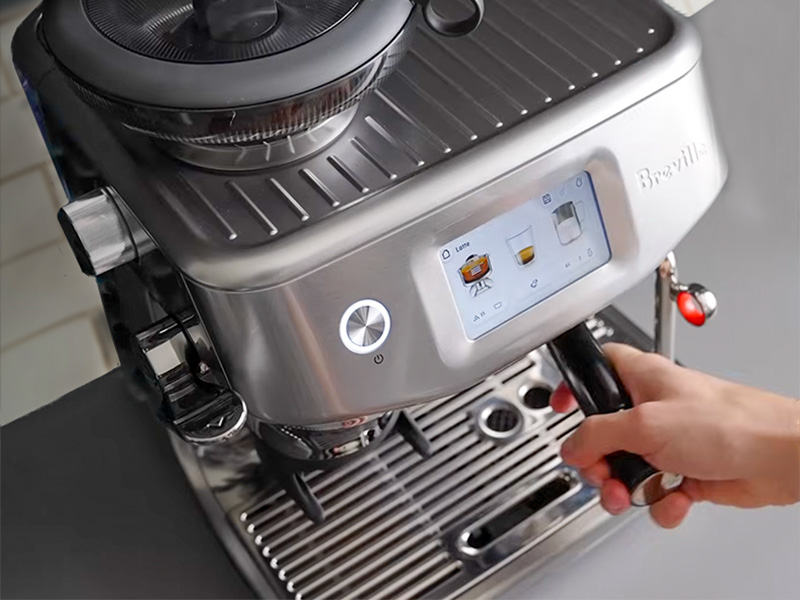
You do this by putting the portafilter in the cradle, then setting the grind setting and grind time. Once the built-in grinder has done its work, you use the tamp assist lever to create your puck. The touchscreen will tell you if you have too much or too little. If it’s too little, grind more; if it’s too much, use the included razor tool to trim it.
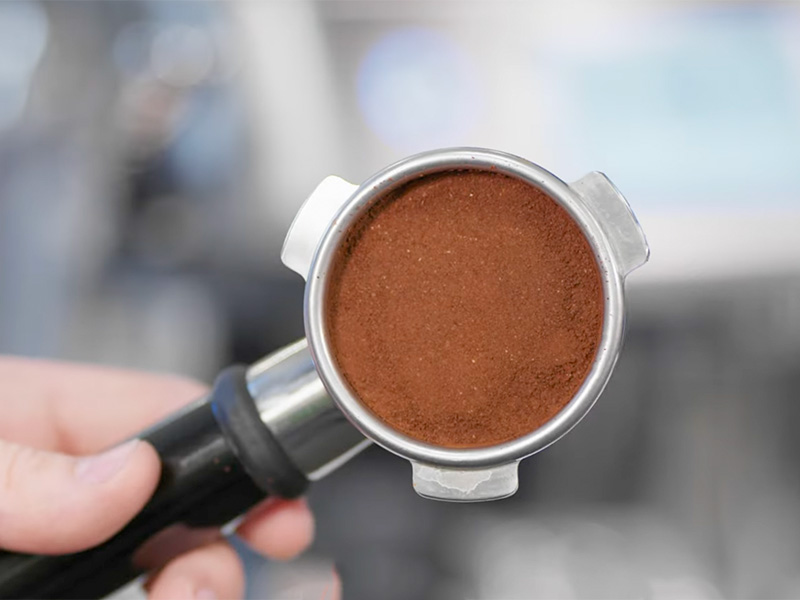
Then you move the portafilter into place for brewing.
If your espresso brews too fast, the Barista Touch Impress will advise you to grind finer. If it brews too slowly, it will tell you to grind coarser.
Realistically, it will take a few attempts to get all your settings right. But this is true of any espresso machine, and the on-screen guidance means you never have to think about it. Just follow the instructions, and you’ll get perfect shots fairly quickly. It took us 6 attempts before we were at the right grind size.
(If you change beans, you’ll have to go through the process again.)
Acing the milk foaming is even easier:
Pour milk into the jug. Pick the temperature you want between 110 and 170°F (in 10° increments). Pick the texture you want – more or less foam, with 8 settings for this. Then select your milk type: dairy, soy, oat, or almond.
The choice of milk type ensures you get the correct texture even with non-dairy alternatives. It works impressively well considering the variation within milk types, never mind between them. We thought the default milk textures were pretty much perfect, too.
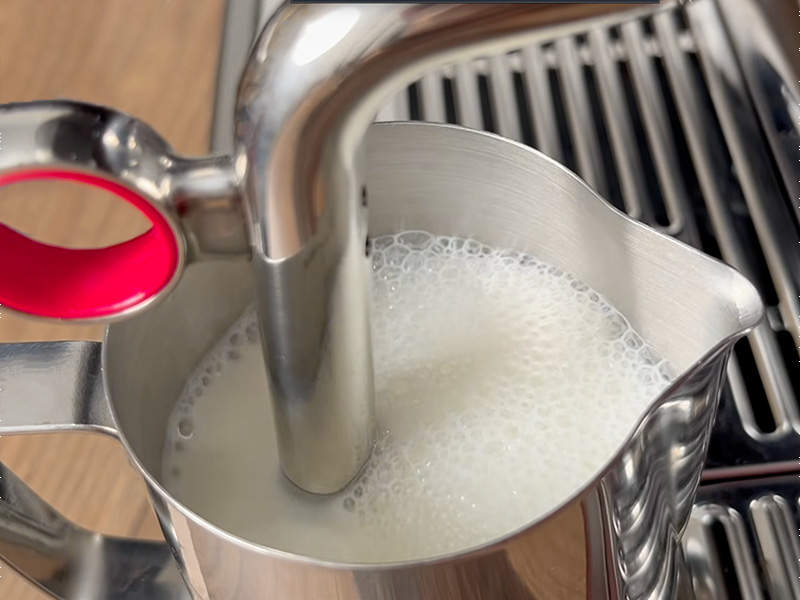
This sounds like a lot, but once you’ve saved your drinks how you like them, you just need to fit the portafilter into the machine and put the milk jug under the wand. Then you can walk away while it brews. You can even choose if it does the milk or coffee first, if that matters to you.
We honestly found it incredibly easy to use. We tried to ignore our pre-existing barista knowledge and only do what the machine told us. It was really amazing how precise the instructions were – it’s almost a waste to have prior experience or intuition with this machine.
Our Breville Barista Touch settings
Using the Barista Guidance on our medium-dark beans, we ended up with:

- Grind setting 14
- Double shot basket with an 18g dose
- Default temperature
- 50ml volume
- We got 35g of espresso out in 27 seconds
For the milk, we tested both dairy and barista-style oat milk (formulated for milk frothing) and found the default temperature and texture settings for cappuccino and flat white were great. My favorite milk-based drink is a cortado, so this instantly went into one of my custom drink slots using the lowest temperature and texture setting 1.

How Good is the Coffee?
Honestly? The coffee from the Breville Barista Touch Impress is extremely good.
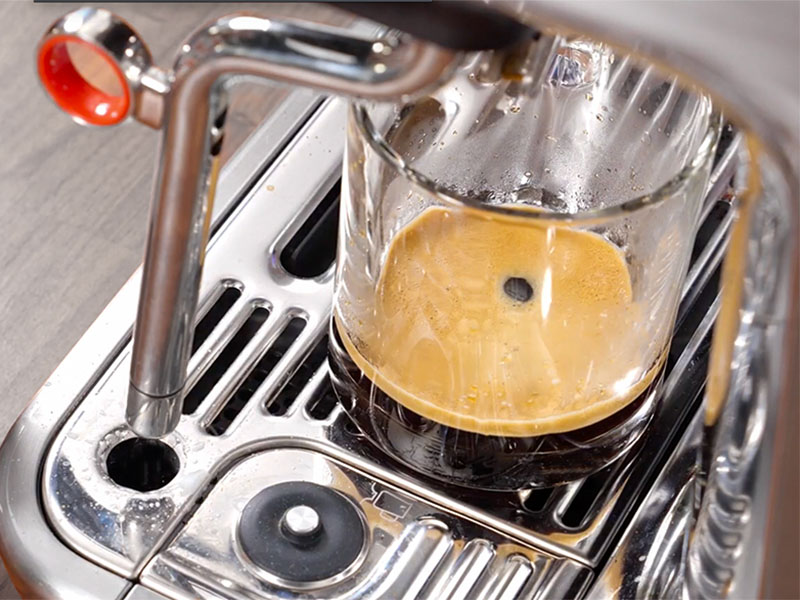
We tested with a medium-dark espresso blend, which is where this machine really excels. The shots were consistently outstanding: rich crema, good body, a clean dark chocolate taste, and a slightly sweet finish that you’d happily pay for in a decent café.
The machine’s PID temperature control is adjustable between 192°F and 203°F (89°C and 95°C), which gives you some room to experiment with lighter roasts if that’s your thing. At 95°C, we got a pleasant fruity shot with good acidity from a lighter-roast Honduran coffee, avoiding the very sour notes that often come through when using automatic machines. Although it wasn’t nearly as delicious as using the medium-dark roast.
The biggest improvement to our Barista Touch Impress shots was by running an empty shot or two before our first real pull (hot water with no coffee). This makes a huge difference to the texture and flavor of the espresso, so it’s worth factoring in enough time for this in your morning routine.
We’ve seen complaints about the accuracy of the intelligent dosing system. For some people, when they weighed the dose on a separate coffee scale, it was wrong by anything up to 1g. On every dose we tested, it was always accurate, so it might be something that Breville managed to fix through a firmware update. But it’s definitely worth keeping in mind.
Milk Quality
The milk frothing is really very impressive for an automated system.
We managed to get great textured milk for latte art, perfect flat white microfoam, and airy cappuccinos at a level we’d normally only expect from a manual wand. The results were consistently good across both dairy and barista-style oat milk.
Don’t get me wrong, we got better milk texture by foaming it manually. But you really don’t have to learn to do it if you don’t want to. We were perfectly happy with the standard milk settings and think most people will be too.
If there’s a lag on the temperature sensor, it can overshoot and go a little hotter than you want. Again, this isn’t a problem that we encountered – we used a separate milk thermometer, and it was always accurate – but we know some people have had issues with this.
During our testing, we only used dairy and oat milk (we can’t stand the flavor of soy or almond milk). So, we can’t speak to how it handles the other non-dairy milks that it’s programmed to handle. But from what we’ve seen, we have no reason to doubt that it would be just as good as dairy or oat.

What Coffee Beans should you use?
While the Breville Barista Touch Impress can handle lighter roasts, medium to medium dark roasts are where it excels.
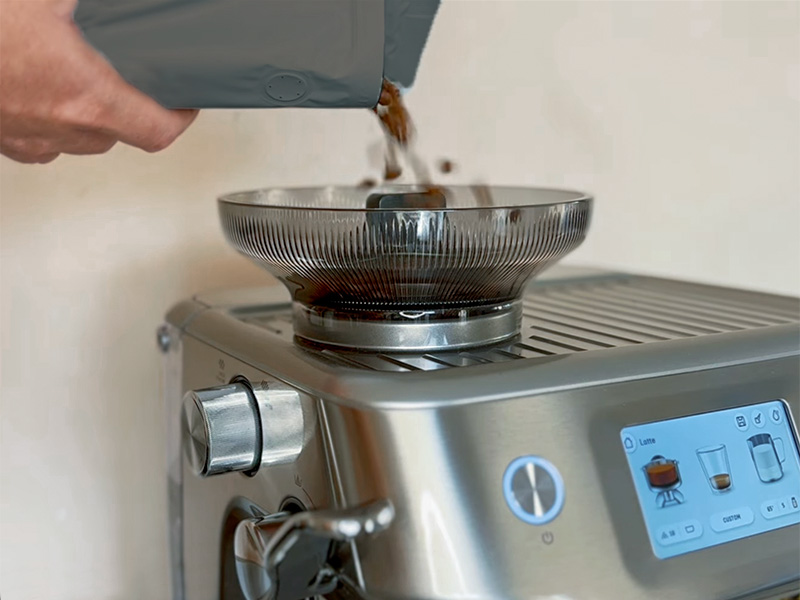
The grinder on the Barista Touch Impress uses 40mm conical burrs made by the excellent grinder company, Baratza. This is very important as the grinder makes an enormous difference to your espresso quality, often much more than the brewing unit.
Several more budget-friendly espresso machines (like the Barista Pro and Barista Express Impress) struggle with lighter roasted beans or high-altitude single origins (like Guatemalan coffee). This is because the beans are denser and harder to get all the good flavor from.
We got decent results from lighter roasts, but this machine really shines with medium to medium-dark roasts. The 30 grind settings give you a good range to get your shots just perfect with whatever your preferred bean is.
If you really wanted to, you could add pre-ground coffee directly to the portafilter. It would be a waste of a great grinder if you did this all the time, but we sometimes do it if we want an occasional decaf without having to clean out the hopper. It’s also the better option if you want an occasional flavored coffee, as the sugars in those beans can destroy your grinder.

Design and Build Quality Review
The Looks
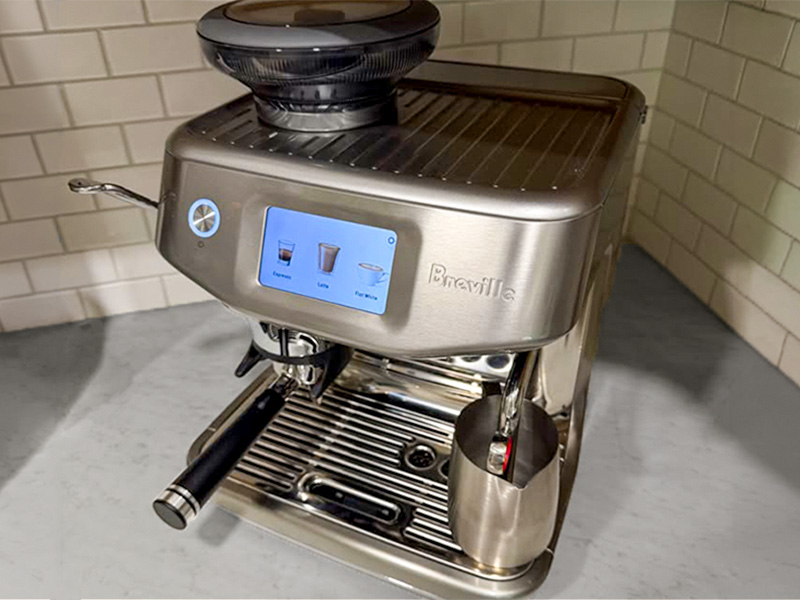
The Barista Touch Impress uses the same modern body design as the Barista Pro, a significant upgrade from the older Barista Express style.
I love the blend of classic espresso machine style with the modern touchscreen. The smoke-coloured bean hopper sits on top, and the only color on the machine is a small red tab on the milk wand, which I could do without, to be honest but I’m boring.
I love stainless steel appliances and the more classic look, but even in a minimalist kitchen, I think this is modern enough to fit in very nicely.
It does come in an array of color options, if you aren’t as color-averse as I am. Some look fantastic, some are what I would generously describe as “bold.” But there’s something for pretty much everyone. You usually need to shop direct with Breville to get the full range of colors though.
One thing to plan for: it’s a big machine. At 14.2 x 13.4 x 16.3 inches, it’s going to take up a meaningful chunk of counter space. Measure before you buy and keep enough room overhead to access the bean hopper.
The Build
On the exterior, everything is stainless steel (except the bean hopper and water tank) and solidly built, which gives the machine a premium feel. It feels like everything is built to last, something we’ve come to expect from a Breville espresso machine – we know people who’ve been using one daily for nearly 10 years.
The tamper lever is solid metal, retracts automatically, and most importantly, you don’t have to push it too hard. The portafilter cradle is also well-made, which you’d expect at this price point.
At the back of the machine, there’s the clear plastic water tank, which is removable for filling. This is the most flimsy-feeling part of the design – so don’t drop it.
We like Breville machines because the quality control is very good and the machines are generally reliable. There is a 2-year warranty too for extra peace of mind.

Psst… If you’re in Europe / UK, you’ll see this machine listed as the SAGE Barista Touch Impress. The only thing that’s different is the Sage or Breville badge on the front – it’s the same machine

Ease of Cleaning
For every cleaning task, the Barista Touch Impress has an on-screen tutorial… but there are quite a few tasks you’ll need to do regularly.
The screen really helps out, regardless of whether you’re a beginner or an old pro. It makes everything as simple as it can be.
In the box, Breville includes a cleaning disc, cleaning tablets, a steam wand cleaning tool, a cleaning brush, and descale powder. So you’ve got everything you need from day one. Buying branded cleaning products can add up over time (and is important for your warranty), so keep that in mind when it comes to running costs.
The cleaning tasks you’ll need to do are:
Daily: Wipe down the steam wand after every use, empty the drip tray regularly (it will beep at you when it’s full), and give the portafilter and basket a rinse. These are all simple tasks that take less than a minute.
Weekly: Backflush with a cleaning tablet. It’s one of the more tedious cleaning tasks that you don’t have to do with a super-automatic/bean-to-cup machine but the Barista Touch Impress walks you through the process step-by-step.
Occasionally: Descale every 6-8 weeks, depending on your water hardness (there’s a water hardness strip in the box to test yours). You’ll need about 30minutes to 1 hour to do this, and it’s definitely one of the less fun cleaning tasks. But a necessary evil of owning any espresso machine.
It’s not a set-and-forget machine, but nothing in this category of espresso machine really is. The guided cleaning via the screen makes it easier to stay on top of. Once you start making coffee, you’ll find you do 90% of the daily cleaning without even thinking about it.

Competition
There are a couple of other good options on the market just now if you’re looking for an espresso machine that lends a helping hand.
DeLonghi La Specialista Touch
- ☕️ Espresso Quality: 9/10
- 🥛 Milk Quality: 9/10
- 📋 Drinks Options: 8/10
- 💸 Value for Money: 7.5/10
- 🏆 Overall Rating: 8/10
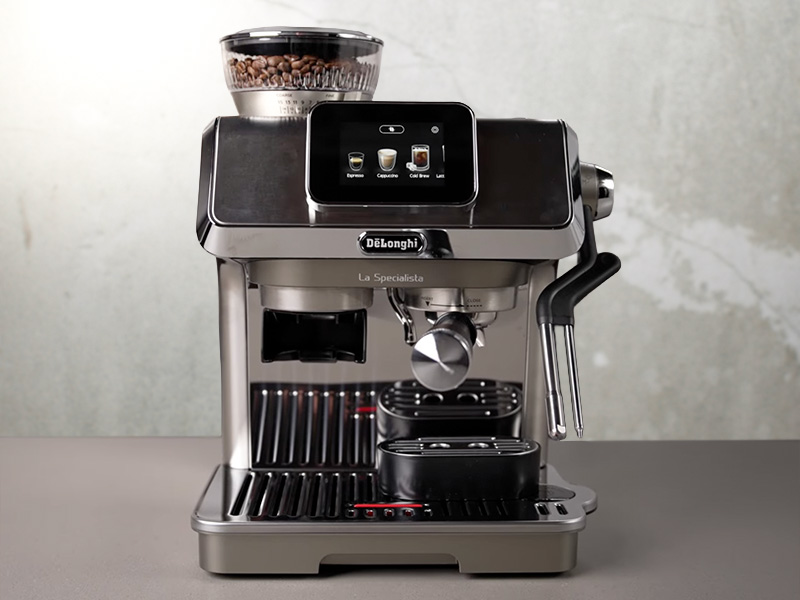
DeLonghi is trying to barge in on Breville’s territory here with a machine designed to help beginners get into home espresso brewing. Rather than a tamping assist system, the La Specialista Touch comes with an array of tools to ensure your coffee puck is perfect for brewing.
This means more effort on your part and some fiddling around in the “dialing in” stage. But it’s also around $500 cheaper than the Barista Touch Impress.
The biggest issue I have with the La Specialista Touch versus the Barista Touch Impress (or any Breville, for that matter) is that it’s just not quite as good at the fundamental level. The boiler isn’t as good, the automated milk frothing isn’t as good, the guidance on dialing in espresso isn’t as good, and the looks aren’t as good.
We’d always rather get a fundamentally better machine, even if it means paying quite a bit more, as coffee quality is always our guiding star.
 Need more info? Check out our full DeLonghi La Specialista Touch review
Breville Barista Express Impress
- ☕️ Espresso Quality: 9/10
- 🥛 Milk Quality: 8/10
- 📋 Drinks Options: 3/10
- 💸 Value for Money: 9/10
- 🏆 Overall Rating: 8/10
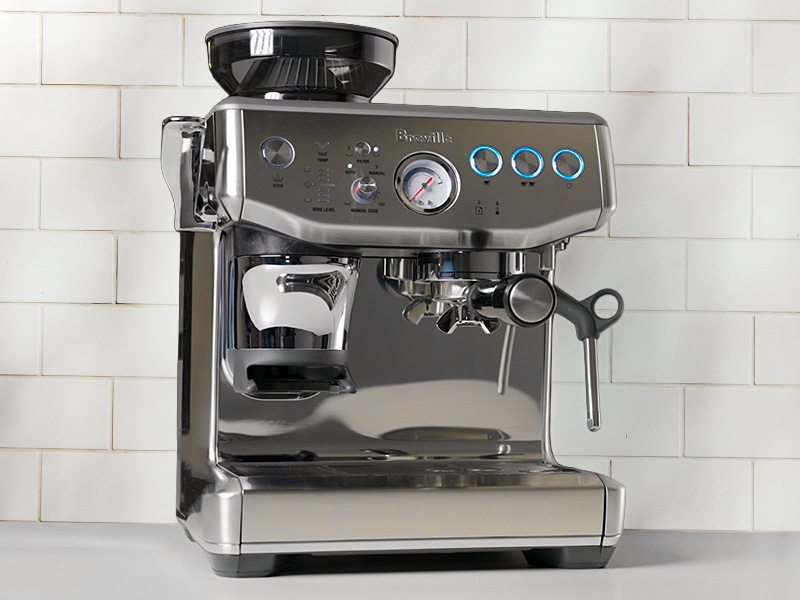
The Express Impress has the same Impress tamping system as the Barista Touch Impress, which is a genuine selling point.
What it doesn’t have is the touchscreen, Auto MilQ, the newer Baratza burrs, or the faster ThermoJet heating. No drink recipes, no safety net.
It uses the older Barista Express body design and is manual milk steaming only. So, if the guided touchscreen experience isn’t something you need and you’re comfortable steaming milk yourself, you can save yourself $600 and still get really solid espresso.
The other thing to point out is that the grinder really does make a huge difference to your espresso experience. But at a $600 price difference, you could buy yourself a seriously good grinder with the Express and still have money left over.
It’s a better option if you already know roughly what you’re doing but would like the assisted dosing and tamping system.
Read next: Our in-depth Breville Barista Express Impress Review
Final Thoughts
A brilliant machine for a very specific type of coffee lover.
The Breville Barista Touch Impress is a really well put-together machine for anyone who wants café-quality espresso at home without needing a barista course to get there. The Impress tamping system removes one of the biggest barriers to consistent home espresso. Using the grind guidance, you can dial in with ease. And once you’re set up, the shots are outstanding.
There are caveats, however, especially at the signifcant pricetag of $1500:
The preset drinks list isn’t extensive and the Auto MilQ steaming has been known to overheat the milk. We had good results with it, but go in knowing you might prefer to steam manually.
If you’re already familiar with pulling espresso shots, then all this extra technology is overkill. You’d be better off getting something much simpler, like the Breville Bambino (see why we rate it) with a separate espresso grinder.
After weeks of testing, our main takeaway for this Breville Barista Touch Impress review is:
This machine rewards patience in the beginning. Give yourself the time to dial it in properly, and it’ll pay you back in genuinely great coffee every single time with next to no effort.
Psst… If the price has you hesitating, we occasionally see it on sale so it’s worth keeping an eye on: