
If you’re looking for a great value espresso machine that’s super easy to use, both Philips and DeLonghi have some solid options. We’ve spent years testing super-automatic espresso machines, including all Philips bean-to-cup machines and almost the whole DeLonghi range – and we don’t hold back on our reviews. Here we’re comparing like-for-like so you can pick the right machine for you, depending on your budget.
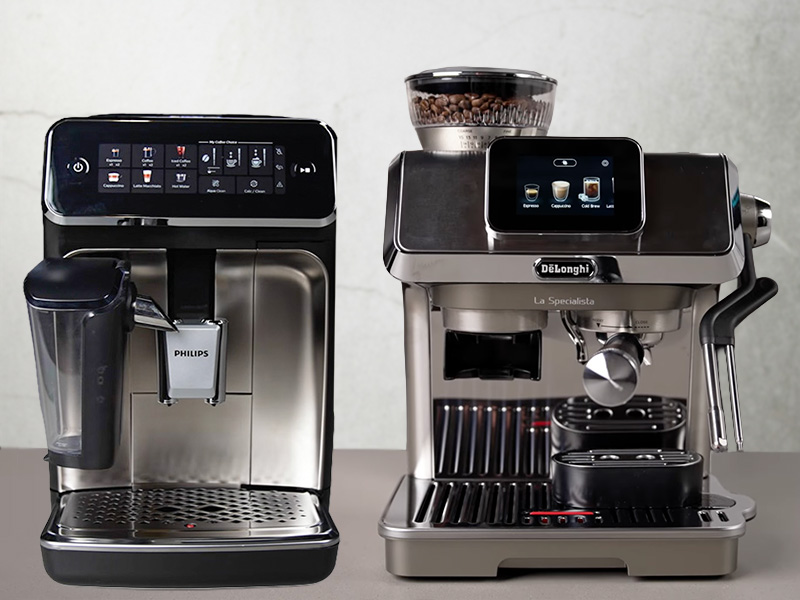
There’s no real competition – DeLonghi makes the better coffee machines. The espresso and milk foam taste better from DeLonghi machines compared to their equivalent-priced Philips model. And isn’t that all that really matters? Having said that, the more expensive Philips machines are often heavily discounted, making them fantastic value for money and a more attractive option.
Everyone has slightly different needs. So, we’ve broken down the main differences between the brands and put their models head-to-head so you can judge for yourself which you want. Pour yourself a cup of the good stuff, and jump right in:
This article may contain affiliate/ compensated links. As an Amazon Associate, we earn from qualifying purchases at no additional cost to you. For more information please see our disclaimer here.

TL;DR Overview
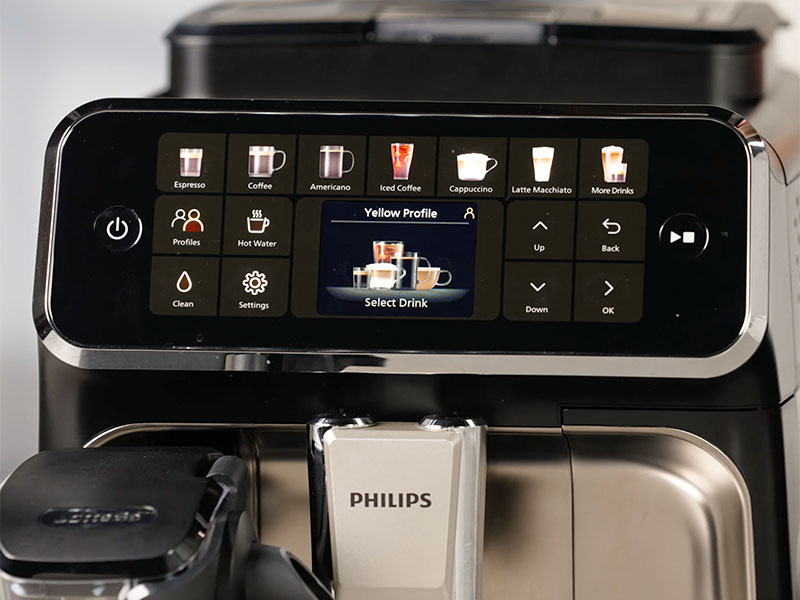
Choose a Philips if you want:
✅ The easiest to use machines
✅ Built-in ceramic coffee grinder
✅ A machine that’s quick to clean
✅ More drinks options
✅ A 2-year warranty
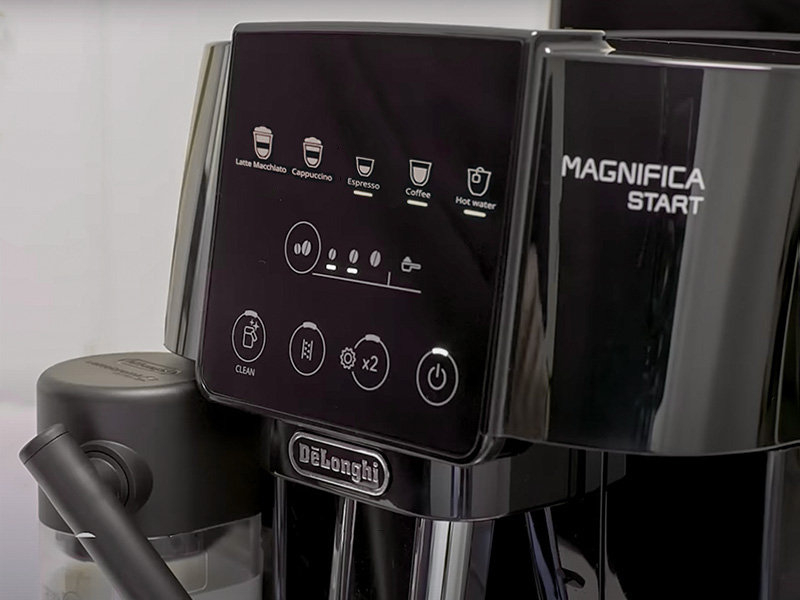
Choose a DeLonghi if you want:
✅ Better coffee quality
✅ More minimalist style of machine
✅ Better milk foam
✅ A 3-year warranty (only when you register your purchase with DeLonghi)

Key Differences: Philips vs DeLonghi
We’re kicking things off with the biggest differences between the two manufacturers across their whole range of espresso machines, so you know what you’re getting yourself into:
Coffee Quality
Let’s get one thing straight: DeLonghi machines make much higher-quality coffee than Philips machines can manage.
This isn’t just our subjective opinion – they’re built with much better coffee-making abilities.
The maximum dose (amount of ground coffee used per shot) is 1-2g higher on DeLonghi machines. This might not sound like a lot, but it’s 10% more than Philips machines use. As a result, the shots are richer, more powerful, and you get slightly more nuanced flavors. Tried side-by-side, the espresso tastes noticeably better from a DeLonghi.
Milk foam is a similar story:
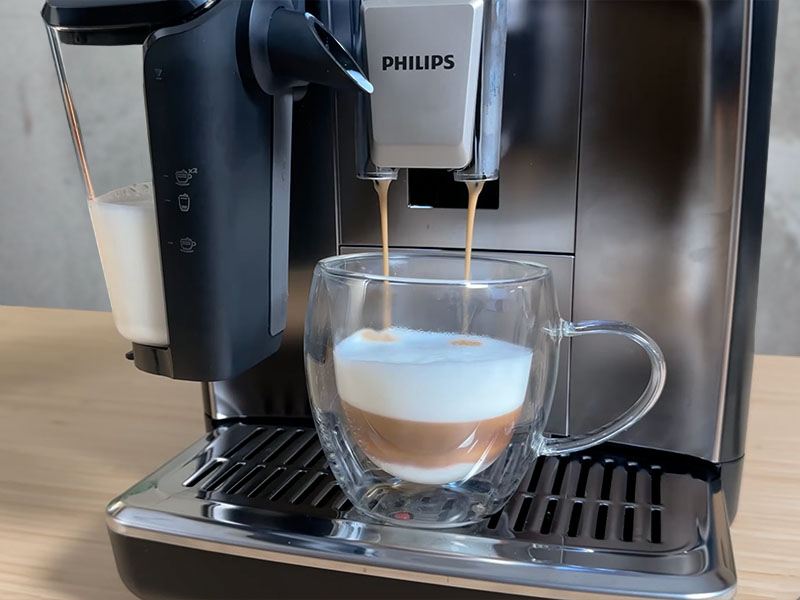
The Philips milk foam is fine, though the bubbles are just a little too big, so the texture doesn’t feel right on a cappuccino or latte macchiato. DeLonghi also produces slightly larger bubbles, but the texture is silkier and generally just more enjoyable to drink.

Philips set up issues
My biggest annoyance with Philips is that you need to run 20+ coffees through their machines before you can get anything drinkable. Whereas DeLonghi machines work straight out of the box.
It’s all to do with the springs that compress the coffee grounds needing to be calibrated, though I have no idea why they don’t just do this as part of the manufacturing process.
Many people don’t realise this and return their Philips machines after their first attempts make a watery, bad-tasting mess of a coffee. Understandable. But you know better now. So if you buy a Philips, we’d recommend getting a bag of cheap beans and just running espressos through the machine that you never drink, before breaking out your good beans. But the hassle alone is a good enough reason to pick a DeLonghi instead.
Features
User Interface
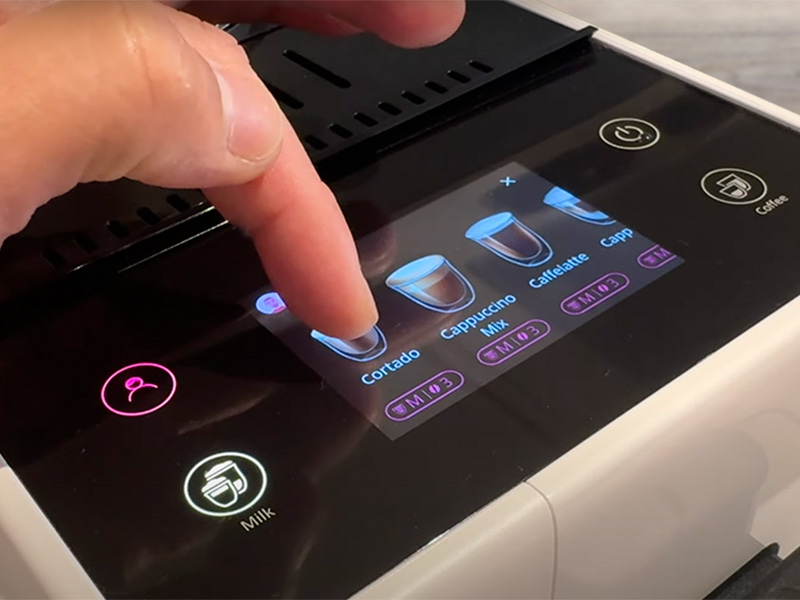
Both companies make it really easy to select and customize your coffee.
They both lean towards buttons (physical or soft touch) for the coffees and simple displays for adjusting strength and length. Although DeLonghi has a wider range of machines, with some of their older models being button-only, and touchscreens starting to appear at the more expensive end.
When you get to the more expensive machines from both, user profiles also become an option. So different members of your household can save their own versions of their favorite drinks.
👀 Psst – We’ve compared all the DeLonghi machines that we’ve personally tested, here
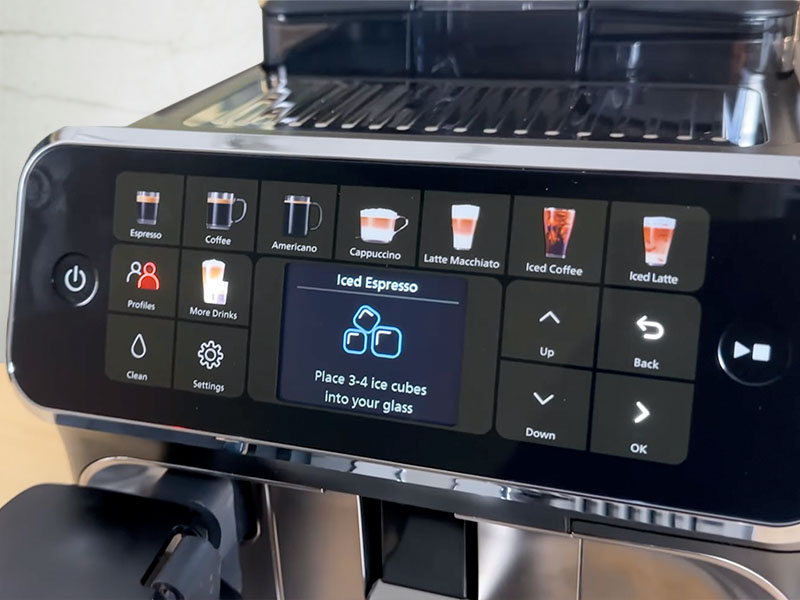
Iced Coffee
Lately, there’s been a big shift towards “over ice” drinks. This is coffee brewed at a lower temperature and poured over ice cubes to create an iced coffee.
Philips outdoes DeLonghi here by introducing milk-based over-ice drinks at a much lower price point.
That said, DeLonghi’s “Cool LatteCrema” system for over ice milk drinks produces better results. But it’s far more expensive – and often it’s an optional add-on which further pushes up the price of your machine.
Bean Adapt
One of our favorite new features from DeLonghi is “Bean Adapt” on their higher-end machines. This is a way for the espresso machine to help you get the best flavor from your coffee beans, using technology to adapt its technique to your chosen beans.
As it stands, Philips doesn’t offer anything similar.
Hoppers
DeLonghi has also introduced replaceable hoppers on the Rivelia, which is another feature we love (read all about it in our Rivelia review). This allows you to easily swap out your beans and, as decaf in the afternoon lovers, this is something we hope to see on more machines in the future.
Looks
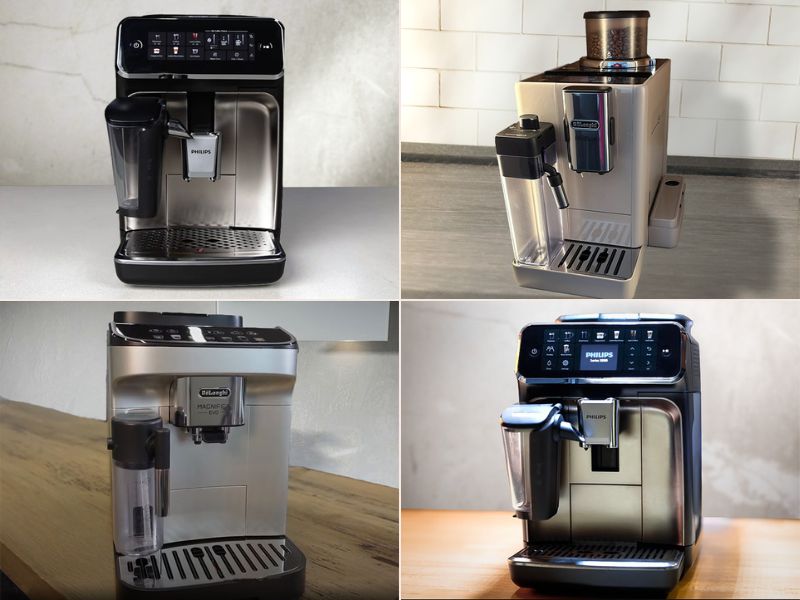
Both DeLonghi and Philips espresso machines lean towards function rather than form.
As you spend more money, DeLonghi machines start to look more premium than the most expensive Philips models. For us, the DeLonghi Rivelia is a considerably prettier machine than the Philips 5500. But that’s an entirely personal choice.
Don’t get me wrong, none of the machines actually look bad. But they won’t all suit your aesthetic. If you prefer a modern minimalist look, then DeLonghi is more likely to have an espresso machine you’ll like than Philips.
Budget
Both companies cater to entry-level budgets (by super-automatic standards, anyway) with some machines in the mid-range.
The thing that makes these two manufacturers so hard to talk about and compare price-wise is that they frequently discount their machines, usually very generously. This means that similarly priced machines are frequently not all that similarly priced.
Philips also only makes super-automatic machines, whereas DeLonghi sells both automatic and manual machines.
We judge everything on the RRP set by the manufacturer and, at the time of writing, their espresso range price range is:
- Philips: $450 – $1700
- DeLonghi: $150 – $2500
But it’s always worth keeping an eye on sales events like Prime Day and Black Friday, as you’ll often find the main models from both DeLonghi and Philips heavily discounted.

Budget Battle: Philips Baristina vs DeLonghi Dedica Maestro Plus
Philips recently released the Baristina as their “entry level” espresso option at $450. And look, I know this is a weird thing to say about an espresso machine, but she cute.
There are much cheaper DeLonghi espresso machines, going all the way down to the Stilosa at $150. But the Dedica Maestro Plus is the closest in price to the Baristina at just under $500.
Philips Baristina
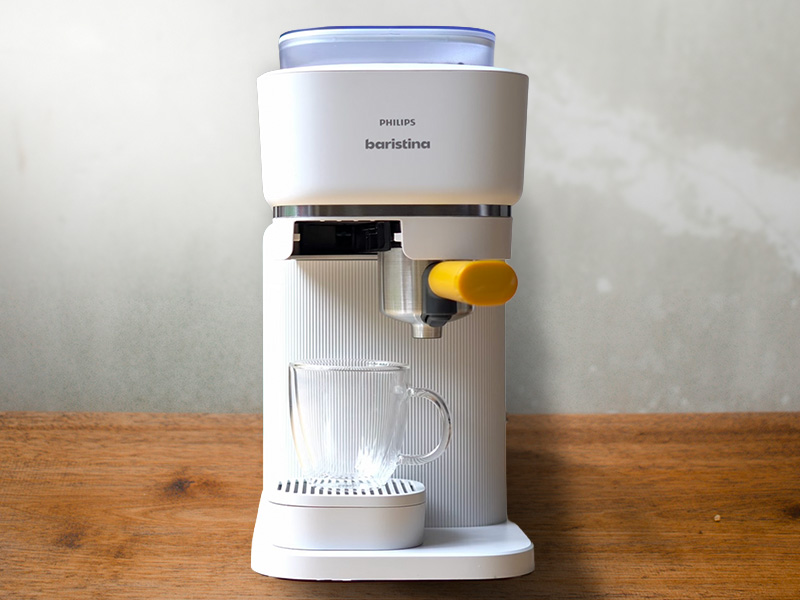
- 7.1 x 14.9 x 13.5 inches (W x D x H)
- Built in grinder
- Espresso or Lungo
- No milk frothing
- 1-year warranty
DeLonghi Dedica Maestro Plus
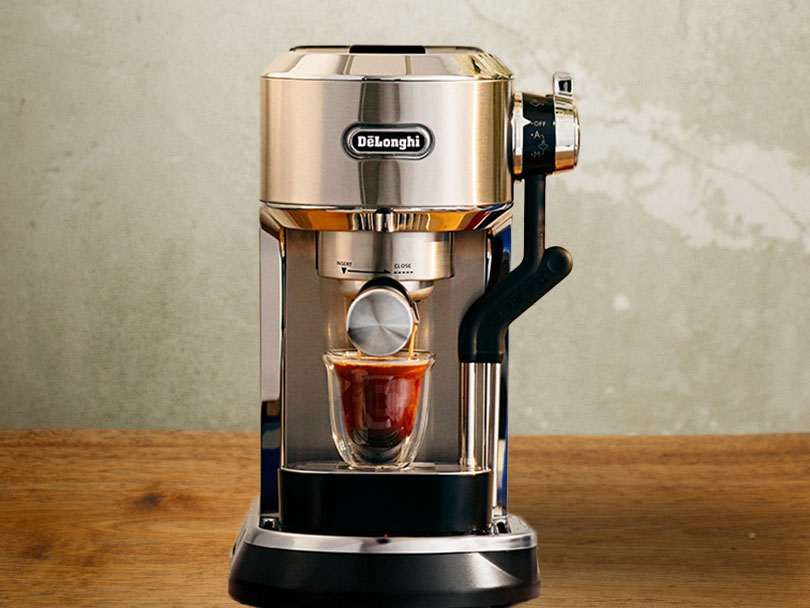
- 8.2 x 13.6 x 12.9 inches (W x D x H)
- No grinder
- Single or double shot
- Auto or manual milk frothing
- 1 year warranty (+1 extra year when registered with DeLonghi)
Both machines are designed to be really easy to use, but they function very differently and, therefore, target very different users.
| Feature | Philips Baristina | DeLonghi Dedica Maestro Plus |
|---|---|---|
| Ease of Use | Extremely easy (only 3 buttons) | Moderate (requires manual dosing/tamping) |
| Coffee Quality | OK – Consistent quality with thick crema | Very good… but only with practice |
| Milk Quality | No milk option | Auto is very good, manual can be better |
| Milk System Cleaning | N/A | Wand needs wiped after each use |
| Drink Options | Espresso or lungo | Single or double espresso |
| Customization | Almost non-existent | Temperature and milk options |
| Calibration Needed | Slightly watery for the first few drinks | Will take a few to get it right |
| Design / Aesthetics | Slick looking, but feels cheap | More premium look and feel |
| Warranty | 1 year | 2 years (with registration) |
| Best For | A step up from pod machines | Learning to pull espresso shots on a budget |
Quick Verdict
👉 Winner: DeLonghi Dedica Maestro Plus
It makes better coffee, has milk foaming options, and a more premium feel
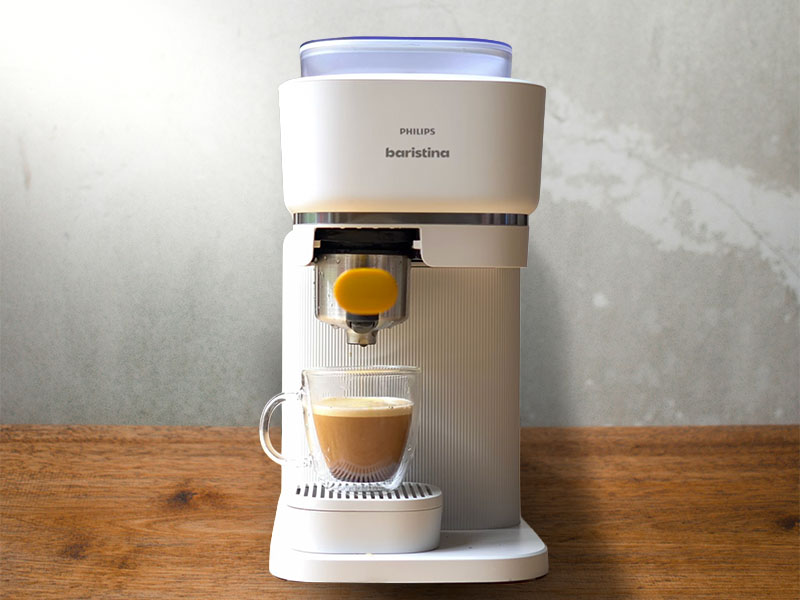
Philips Baristina
The Baristina is designed to compete with pod machines like Nespresso or Keurig. But with the benefits of a grinder and portafilter instead of a coffee pod, meaning fresher coffee and freedom to choose your own beans.
You simply add your favorite beans, push a button, slide the portafilter across to the right, and off it goes. The Baristina automatically grinds, tamps, and extracts your espresso shot so you get consistent quality every time.
The interface is simple with just 3 buttons – one for espresso, lungo, and the 3rd to add extra coffee to either drink. Pressing the third button delivers a more intense flavor, which we much preferred over the ‘meh’ regular shots.
You can also adjust the length of either drink by pressing and holding the button for 5 seconds, then again once your preferred volume has been dispensed. Honestly, I don’t think you need to, especially as it’s a little awkward. That is the total of the customization options for this machine.
My favorite thing about this machine is its looks – certainly a better fit in modern kitchens than the Dedica Maestro Plus. The textured plastic gives it a premium edge.
But that doesn’t translate to how it feels. Unfortunately, it feels cheaply made – the water tank is a bit flimsy, and the portafilter has more plastic than I’d like.
If you’re upgrading from a pod machine, the coffee quality is undoubtedly better without being any more difficult to use or clean.
But with no milk foaming, no grind adjustment, espresso quality that’s just okay, and a generally cheap feeling (despite being a $450 machine), we’re not convinced.
DeLonghi Dedica Maestro Plus
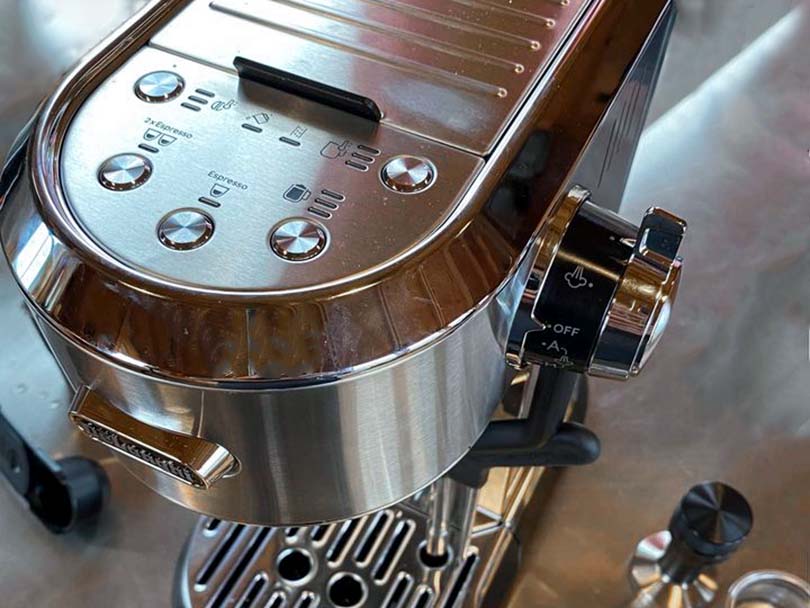
As a more manual machine, the Dedica Maestro Plus is very obviously aimed at a different crowd:
It’s equally compact, but comes with an automatic milk wand and the requirement for you to take control of the espresso-making process. You have to dose, grind, and tamp your beans – all of which introduce more opportunities for greatness, but also mistakes.
To make things more forgiving when you’re getting started, it comes with beginner-friendly double-walled filter baskets. Once you get the hang of things, you can progress to the single-walled ones. Both have a maximum dose of 20g (double espresso).
This machine is designed for people who want to pull proper espresso shots at home but are short on space. So there is greater potential in your drinks’ quality, but you have to be willing to put in the effort. The same goes for milk drinks – the automated milk does work nicely, but the potential and flexibility are greater when you switch to manual.
The stainless steel looks nice, even if there is still a lot of plastic involved in the overall construction. Everything feels really well-made – there’s no flimsy parts, and the included accessories work well.
All the praise aside, it’s not our favorite espresso machine of this type at this price; the Breville Bambino Plus is much superior (see why in our full review). But it’s a really great espresso maker, if you want to do the work to pull espresso shots and are short on space.
The Winner
These two machines are aimed at completely different people:
➡️ Pick the DeLonghi Dedica Maestro Plus if you’re looking for a better espresso machine that will produce better coffee and excellent milk foam… when you put in the work.
➡️ Pick the Philips Baristina if you want your coffee quickly and easily. At the push of a button, you get coffee that’s better than a pod machine, while being as simple to use and clean. And it also looks great. You can always buy a separate milk frother if that’s your sticking point.
“Budget” Super-Automatics: Philips 3300 vs DeLonghi Magnifica Evo
The entry-level machine in Philips’ super-automatic range is the 3300. DeLonghi has a huge number of variations of their “entry-level” Magnifica range, but the Magnifica Evo with LatteCrema is the same RRP as the 3300, so it’s the best option to compare head-to-head.
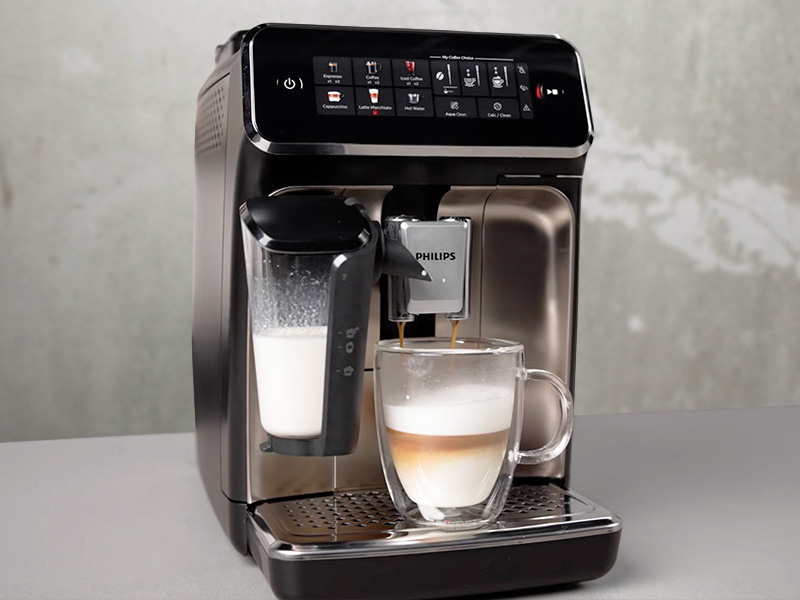
Philips 3300
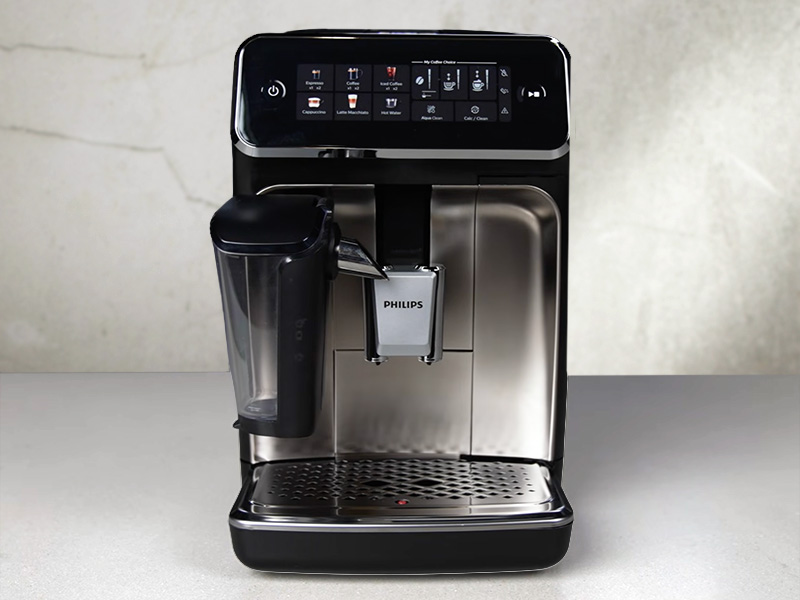
- 9.7 x 17 x 14.6 inches (W x D x H)
- 5 coffee options (plus hot water)
- Easy to clean automatic milk system
- Buttons with LEDs to coffee/customize
- 1-year warranty
 Want more? Read our full Philips 3300 review
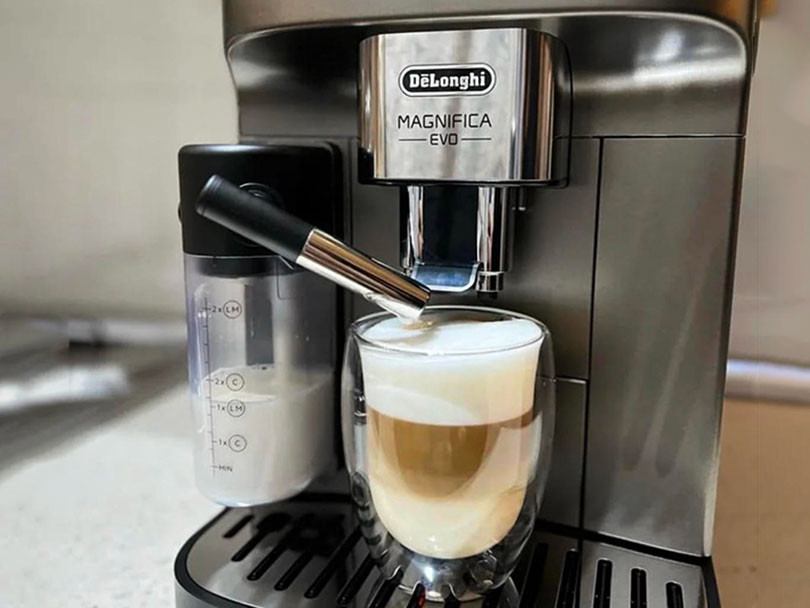
DeLonghi Magnifica Evo with LatteCrema
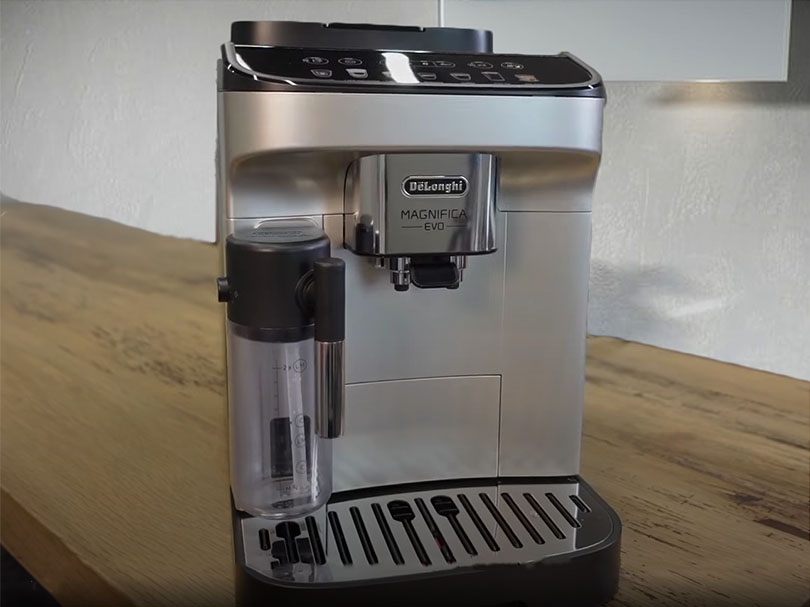
- 9.5 x 17.3 x 14.2 inches (W x D x H)
- 5 coffee options (plus 1 custom “My Latte” and hot water)
- Automatic milk system
- Buttons selecting coffee/customization
- 1 year warranty (+1 extra year when registered with DeLonghi)
This isn’t a trick; these machines are different. But different in the way everyone in a friend group wearing the current trend are “different”. Instead of “who wore it best,” this is more “which does it best,” as the basic functions of these two machines are extremely similar.
| Feature | Philips 3300 | DeLonghi Magnifica Evo (LatteCrema) |
|---|---|---|
| Ease of Use | Extremely easy (LED + buttons) | Very easy soft-touch buttons (slightly more complex) |
| Coffee Quality | Good (after calibration) | Better out of the box |
| Milk Quality | Good, slightly airy foam | Better texture, more refined |
| Milk System Cleaning | Excellent (very simple, 2 parts) | Good (more parts than Philips) |
| Drink Options | 5 drinks | 5 + 1 customizable (“My Latte”) |
| Customization | Basic but clear | Slightly more flexible |
| Calibration Needed | Yes (10–30 cycles) | No |
| Design / Aesthetics | Functional, basic | More modern, premium feel |
| Warranty | 1 year | 1–2 years (with registration) |
| Best For | Beginners who want simplicity | Better coffee with minimal effort |
Quick Verdict
👉 Winner: DeLonghi Magnifica Evo
It makes better coffee and works straight out of the box (without calibration), while still being beginner-friendly.
Philips 3300
As one of the easiest super-automatic coffee machines you can find, the Philips 3300 is the entry point into their range. All their machines have the same internal parts, so you’re paying for more or less functionality as you move through their range (less in the case of the 3300).
I like the simplicity of the display. All your settings are shown via LEDs, so you can clearly see how strong and long your coffee will be before it’s made. It’s also easy to adjust by pushing the relevant buttons to cycle through the settings.
Looks-wise, I just don’t think it’s the prettiest machine out there. And it doesn’t offer a lot of options, though I’m willing to forgive that for how easy it is to use – which is Philips’ whole vibe.
But the biggest negative of the 3300, and all Philips machines, is that they need to be “calibrated”. I just find it hard to get on board with any machine that needs me to make and trash 30 coffees before I get anything good. This isn’t a problem we’ve ever run into with DeLonghi.
Coffee issues aside, the milk system works great and is ludicrously easy to clean. It’s made of just 2 pieces, so there’s no narrow tubing or fiddly bits to contend with. In 30 seconds, you’re done. I can’t say enough about how great it is not to worry about the milk system being clean.
DeLonghi Magnifica Evo with LatteCrema
The Magnifica Evo with LatteCrema is more of a mid-range machine from DeLonghi. The extra coffee option that it has over the Philips 3300 is called “My Latte.” This can be programmed by you to be whatever milk-based drink you like. So you kinda get an extra option.
I know looks aren’t everything, but this machine looks a lot nicer than the Philips, which is important when it takes up this much room.
The backlit icons and soft-touch buttons for adjusting the strength look (and feel) more modern. But they’re angled upwards, which doesn’t bother me, but my wife is short and finds it quite awkward to see. Overall, it isn’t quite as easy to adjust as the Philips, but it’s pretty close.
Plus, you don’t have the “calibration” issues. Though it will likely still take a few tries to get your coffee just as you like it.
The Magnifica Evo also has an excellent milk system, or you can get it with a Panarello steam wand if you prefer. Nothing is as easy to clean as the Philips milk system, but this is still pretty good.
The Winner
This one’s easy:
✅ Pick the DeLonghi Magnifica Evo with LatteCrema. It’s the clear winner as the coffee tastes better, and it looks nicer. Plus, it works straight away – the calibration issues on the Philips 3300 are an annoyance we’d rather not have to deal with.
❌ The ease of use and fantastic milk cleaning aren’t enough for the 3300 to make up for these flaws. Unless the price is massively discounted – we’re a sucker for a good deal.

Mid-Range: Philips 44000 vs DeLonghi La Specialista Touch
Usually found for around the same price (the $1000 mark), these two machines are still “affordable” (as super-automatic espresso machines go) but offer the added convenience that many people are looking for.
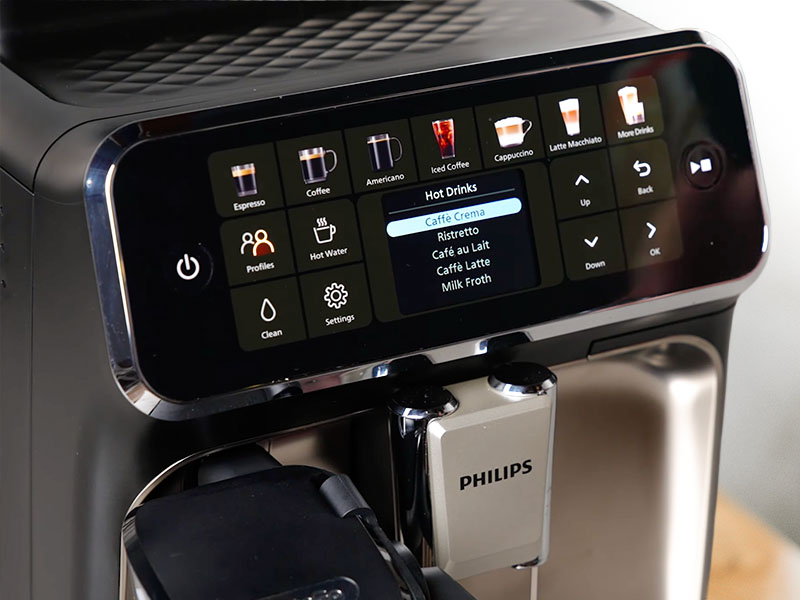
Philips 4400
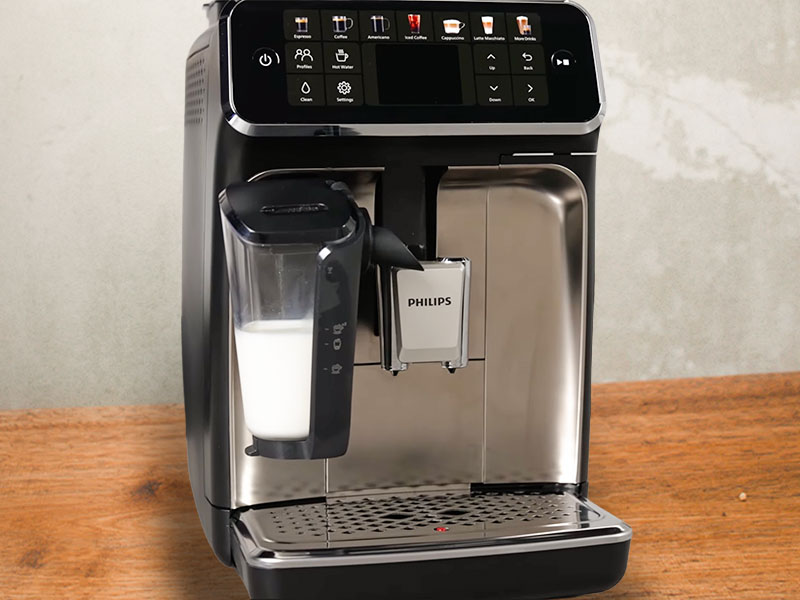
- 9.7 x 17 x 14.6 inches (W x D x H)
- 12 pre-programmed drinks (plus hot water and milk foam)
- Automatic milk frothing
- Ceramic grinder with 10 settings
- Color screen with buttons
- 1-year warranty
Want more? Read our full Philips 4400 Review
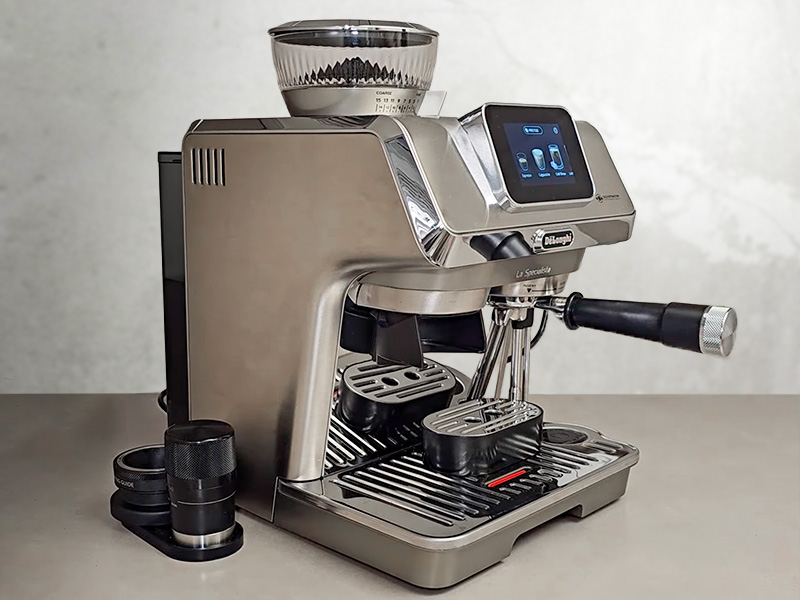
DeLonghi La Specialista Touch
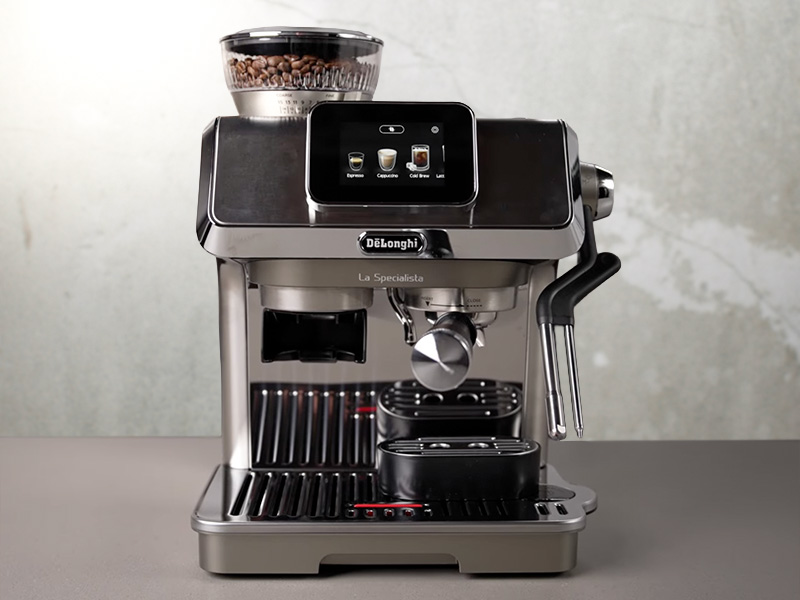
- 14.4 x 11.2 x 15.9 inches (W x D x H)
- 8 pre-programmed drinks (plus hot water and hot milk)
- Automatic milk frothing
- Stainless steel grinder with 13 settings
- Color touchscreen
- 2-year warranty (+1 extra year when registered with DeLonghi)
Need more info? Read our hands-on DeLonghi La Specialista Touch review
These are very different looking espresso machines that are very different to use.
DeLonghi doesn’t have a super automatic option at the $1000 price point, which surprised us, to be honest. So you’ll have to do some of the work yourself, though the La Specialista Touch will still brew the coffee and foam the milk for you.
| Feature | Philips 4400 | DeLonghi La Specialista Touch |
|---|---|---|
| Ease of Use | Very easy (fully automatic) | Moderate (semi-automatic workflow) |
| Coffee Quality | Good | Much higher quality |
| Milk Quality | Good – automatic | Excellent (customizable textures) |
| Milk System Cleaning | Very easy | More manual cleaning required |
| Drink Options | 12 drinks | 8 customizable drinks |
| Customization | Limited | High (grind, dose, milk texture) |
| Iced Coffee Options | Yes (including milk drinks) | Yes (better cold brew quality) |
| User Effort | Minimal | Higher (tamping, setup) |
| Design / Interface | Simple color screen | Premium touchscreen + tools |
| Best For | Convenience-focused beginners | Users wanting to learn espresso skills |
Quick Verdict
👉 For most users: the Philips 4400 is the winner
It offers the easiest, push-button option for a decent cup of coffee
👉 But: Choose the DeLonghi La Specialista Touch if you want to up your skills with better coffee and more control
Philips 4400
A very obvious step up from the 3300 in terms of looks and drinks options while keeping a lot of the simplicity and ease that makes the 3300 so attractive to new espresso machine users.
Maybe the most important (and my favorite) addition is the “iced espresso” drink option. This brews espresso at a cooler temperature, designed to be poured over ice cubes for a chilled espresso shot. And it does a really good job of it, opening up the door to near-endless options of iced coffees with ease.
The internal parts are all the same as the 3300 (and the 5500, for that matter). So you’re not getting any better coffee or milk for your money. Just more options and a different user interface.
The iced coffees are good, the milk system is still a joy to clean, and it’s so simple to use that literally anyone will master it in a day.
Sure, it’s not the best quality coffee and milk you can find for around $1000. But simplicity is the real aim of the Philips 4400, and it does that extremely well.
DeLonghi La Specialista Touch
The La Specialista Touch is a very different animal from the Philips machines. There is a lot more work for you to do, though you are helped at every single stage. The results have far superior potential though.
Much better coffee, much better milk, and much better customization.
The La Specialista supplies you with tools to ensure you have the right amount of coffee in the portafilter and it’s tamped correctly. Often, the included tools are pretty meh, but I was pleasantly surprised.
Once you’ve set the right volume for the specific beans you’re using, you can save those beans so the machine knows how much to grind from then on. If you change beans, you go through the process again, but for many people, it’ll be a “one and done”. This makes it so much easier for you to get the very best tasting cup of coffee from your machine, which I love.
The steam wand can be customized to different temperatures and different milk textures. This means latte art flat whites are possible, as are super foamy cappuccinos. The Philips machines don’t come close to producing both.
Whilst there are only 8 pre-programmed drinks, you can customize them all to be exactly how you like. The cold brew drinks also taste much better than the “over ice” options from Philips. Brewed much more slowly at lower temperatures.
It’s just a lot more work to use. Both the setup, the brewing, and the cleaning are a little bit more work than with the Philips 4400 – it’s aimed at a very different audience.
If you want to learn to pull espresso shots and foam milk then this is a great starting point as it’ll help you through the growing pains.
The Winner
🏆 The Philips 4400 is the winner here, as most people choosing between Philips and DeLonghi will be after a machine that’s really easy to use.
☕️ The La Specialista Touch makes better coffee and milk, but the extra work that you need to put in means it’s aimed at a very specific audience. If you’re that audience, then the La Specialista Touch is a really good option.

High End: Philips 5500 vs DeLonghi Magnifica Plus
At the time of writing, the Philips 5500 is currently their top offering (though there are rumours of a more premium machine dropping soon). DeLonghi’s top-of-the-line machine (the Rivelia) is significantly more expensive, so we’re comparing it to the DeLonghi Magnifica Plus instead, as they both sit around $1300 RRP.
Philips 5500
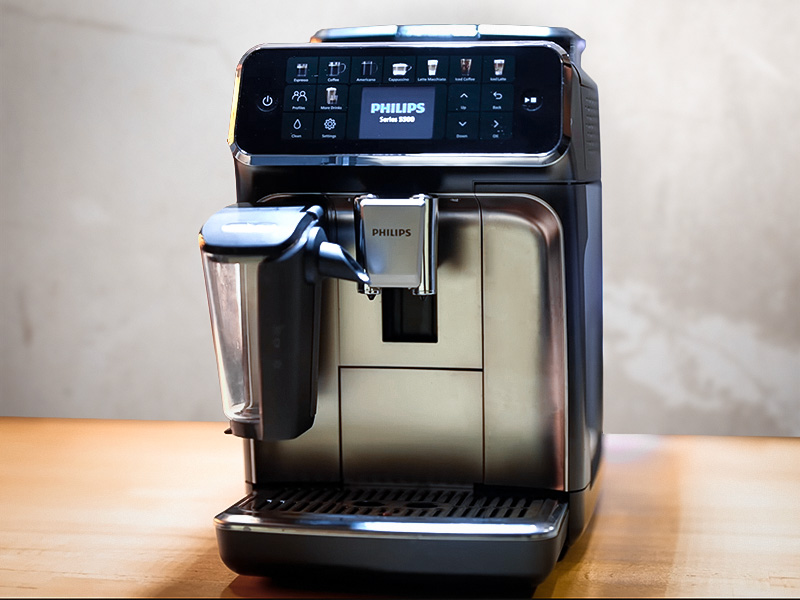
- 9.7 x 17 x 14.6 inches (W x D x H)
- 18 pre-programmed drinks (plus hot water and frothed milk)
- Extra shot option
- 4 user profiles
- 10 grind settings
- Color screen with buttons
- 1-year warranty
Want more info? Read our full Philips 5500 Review
DeLonghi Magnifica Plus
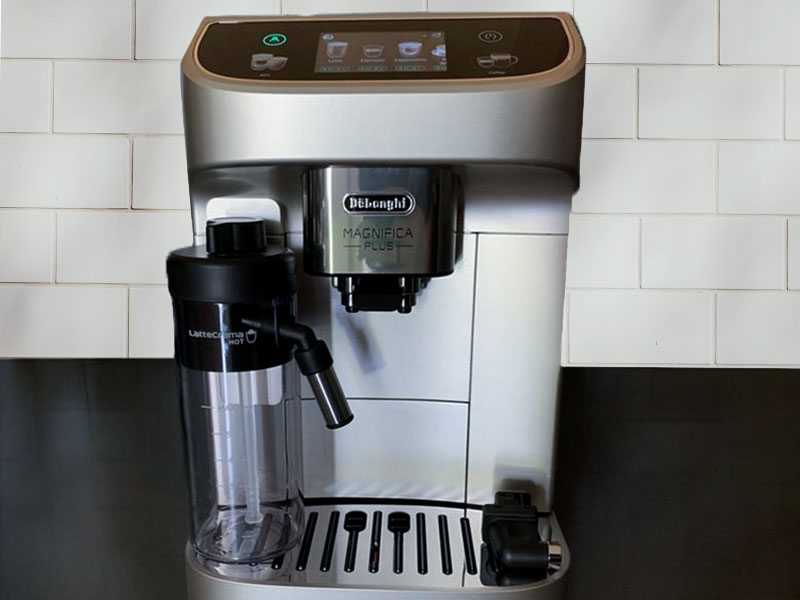
- 10.3 x 17.5 x 15.1 inches (W x D x H)
- 16 pre-programmed drinks (plus hot water and hot milk)
- 4 user profiles
- 13 grind settings
- Touchscreen and soft touch buttons
- 2 year warranty (+1 extra year when registered with DeLonghi)
Read next – Our hands-on Magnifica Plus Review
They’re both strong options that make it very easy to just push a button and get a decent cup of coffee. But they do have some important differences:
| Feature | Philips 5500 | DeLonghi Magnifica Plus |
|---|---|---|
| Ease of Use | Very easy | Easy (slightly more interaction) |
| Coffee Quality | Good (improved with “extra shot”) | Better overall |
| Milk Quality | Good | Slightly better |
| Milk System Cleaning | Best-in-class simplicity | More involved |
| Drink Options | 18 drinks | 16 drinks |
| Customization | Moderate | Moderate to high |
| Special Features | Extra shot + iced milk drinks | Bean Adapt, touchscreen UI |
| User Profiles | 4 profiles | 4 profiles |
| Calibration Needed | Yes | No |
| Design / Interface | Functional | More premium, modern |
| Price Value | Often discounted (great value) | Higher at full price |
| Best For | Convenience + variety | Better coffee quality |
Quick Verdict
👉 Winner: When they’re both full price, the DeLonghi Magnifica Plus takes the W. Comparing the coffee quality head-to-head, it always comes out on top.
👉 Best Value: When it’s discounted, the Philips 5500 is a very attractive option
Philips 5500
The top-of-the-range Philips machine packs a lot of extras over the 4400, including one feature that makes a huge difference to your coffee quality: the “extra shot” function.
It’s confusingly named, as it doesn’t make your drinks a double. Instead, it uses the same volume of water but twice the amount of ground coffee. The result is much stronger, richer, and fuller-bodied coffees.
Just like the previous generations, it’s the same basic machine. So there are no changes to the internal parts, milk frother, or dimensions. This also means it has calibration issues, sadly. Sure, you get more drink options and that extra-shot function, but at full retail price, I’m not convinced the 5500 is worth it.
But when you find one under $1000 – as it often is in the sales – it becomes a really great value machine.
Having more drinks does make the 5500 a little more complex to use. You have to scroll through some menus to select a few of the options. The user profiles are very helpful, though. Each profile can save settings for each drink, so you can have 4 unique versions of every coffee. Plus, there’s a “guest” profile for people to freewheel the settings.
One thing to really consider is that Philips has 3 “over ice” milk-based drinks to choose from. They’re not fantastic, but they’re pretty good and very rare at this price point.
DeLonghi Magnifica Plus
This is the most expensive option in DeLonghi’s large and confusing Magnifica range.
It doesn’t offer the same range of coffee options as the Philips despite having only two fewer recipes. There are 3 cappuccino variations, which I’m not convinced anyone needs, and they include 2x espresso in their list. It does offer cortado, though, which the Philips does not.
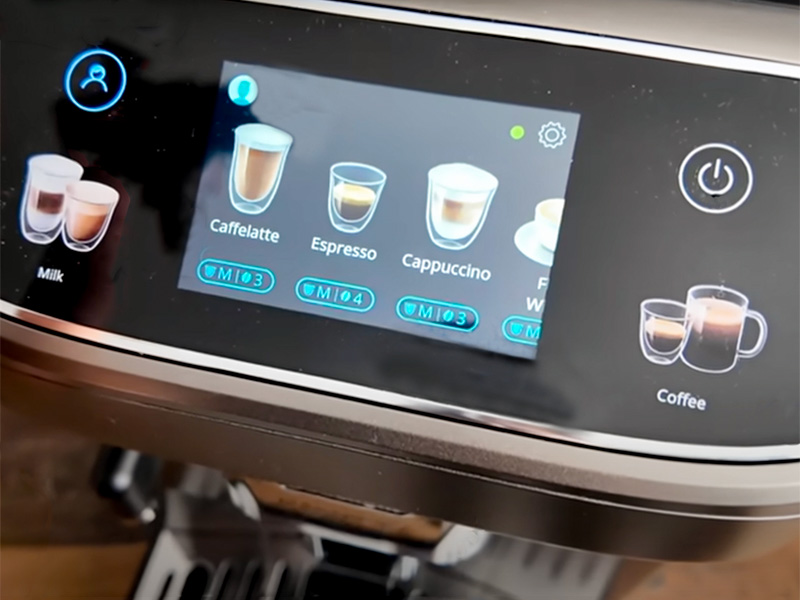
The touchscreen is very nice, though I find that it needs firmer taps than is ideal. Plus, there are two soft-touch buttons to let you quickly scroll just the black or the milk-based coffees, which we appreciate.
It’s a little harder to clean, entirely due to that milk container on the Philips being so brilliant. But the coffee is definitely better, and the milk is marginally better. If it had the “extra shot” function that Philips has, then it’d be the winner by miles.
The DeLonghi Magnifica Plus does offer 2 over-ice coffees but just coffee and an Americano. There are no milk-based options nor espresso, which could be the decision maker for you.
The Winner
🏆 The DeLonghi Magnifica Plus makes better coffee and milk so for most people, it will be the better option.
🥈 That being said, the extra shot function and the iced coffee recipes on the Philips 5500 are nice features that are worth considering.
Looking at both machines at their RRP of $1300, I want the better quality offered by the DeLonghi. However, since the 5500 is often discounted to under $1000, I wouldn’t hesitate to recommend the Philips when it is on sale.
Want to see how DeLonghi measures up against some other giants of the espresso machine world? Check out these guides next:
💸 DeLonghi vs Jura: A spend or splurge showdown
☕️ Gaggia vs DeLonghi: Do you want more choice or better coffee?
💡 Breville vs DeLonghi: Who makes the best espresso machines?

Final Thoughts
In a sweeping generalization, DeLonghi machines have higher milk and coffee quality for the same price. But Philips machines are easier to use and are often much cheaper.
But it’s hard to pick an outright ‘better’ company out of Philips vs DeLonghi, as their ranges are very different in size, and they both frequently run extensive sales events. It’s always best to check the prices before choosing, as a slightly lesser espresso machine that’s several hundred dollars cheaper is probably a great deal.